

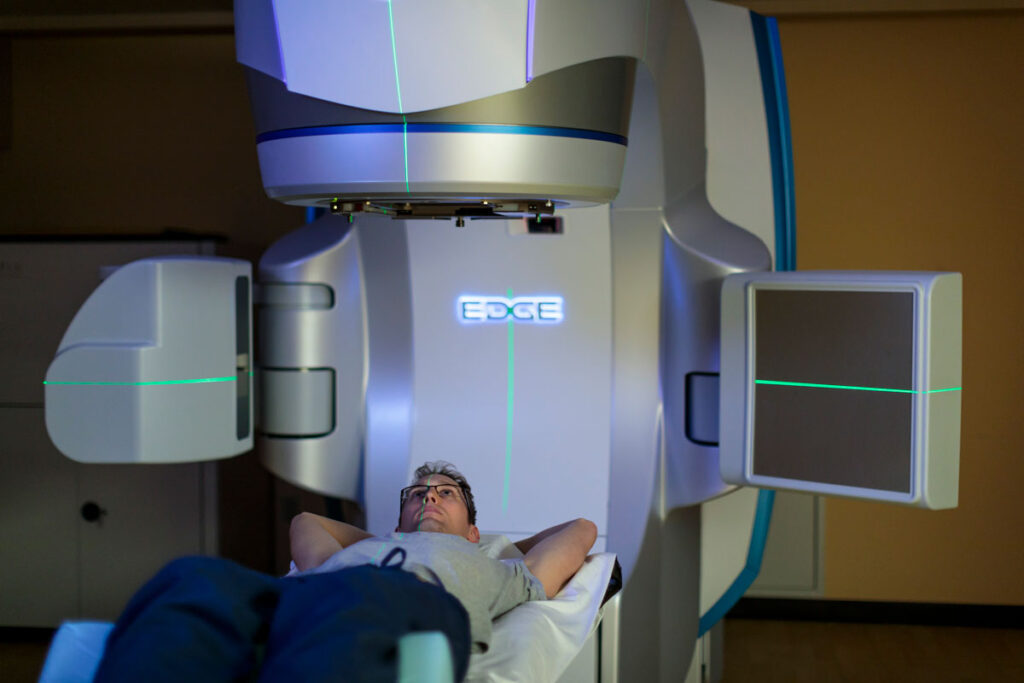
A promising study evaluating the use of ultra-hypofractionation radiation therapy for the treatment of high-risk prostate cancer is underway at all six locations of Siteman Cancer Center, based at Barnes-Jewish Hospital and WashU Medicine.
Called the “High Five” clinical trial, or NRG-GU-013, the phase III multicenter study will help determine whether five high-dose stereotactic body radiation therapy (SBRT) treatments over two weeks is as effective as current standard-of-care radiation therapy, which consists of five standard doses per week for four to nine weeks, totaling 20-45 treatments.
“This trial may re-shape how prostate cancer is treated for high-risk men,” said WashU Medicine radiation oncologist Lannis Hall, MD, MPH, principal investigator of the study and director of radiation oncology at Siteman Cancer Center at Barnes-Jewish St. Peters Hospital. Hall also serves as co-chair of the Clinical Research Committee for Siteman Cancer Center.
Earlier research, published in the New England Journal of Medicine in October 2024, found that five-fraction SBRT is a viable treatment option for patients with localized, low-to-intermediate-risk prostate cancer and was just as effective as the longer lower-dose radiotherapy treatments. Researchers now are evaluating its impact on high-risk prostate cancer.
“We now have robust clinical trial data from multiple countries demonstrating the excellent efficacy and safety of ultra-hypofractionation,” Hall said. “This condensed treatment schedule requires just one and a half weeks and has been incredibly well received by our patients, whether in urban centers or rural areas. It dramatically reduces the time, travel and financial burden associated with care, making it far more accessible.”
She added, “For patients struggling to fit treatment into their already demanding lives, this approach could be a true game changer. And, if proven to be equally effective long-term for high-risk men, it has the potential to improve outcomes for countless men who might otherwise forgo curative treatment.”
Siteman Cancer Center currently leads the nation for patient participation in the NRG-GU-013 trial, which is set to enroll 1,200 men, with half receiving standard-of-care therapy and the other half receiving SBRT ultra-hypofractionation radiation treatment. The study is coordinated through the NRG Oncology Cancer Cooperative Group, one of five national cancer groups funded by the National Cancer Institute as part of the National Clinical Trials network (NCTN). Siteman treats more than 1,000 newly diagnosed prostate cancer patients each year.
Adaptive SBRT and Microboost Radiation Therapy for High-Risk and Unfavorable Intermediate-Risk Prostate Cancer
In addition to NRG-GU-013, WashU Medicine researchers at Siteman Cancer Center are reviewing early results from their Investigator Initiated Trial using ultra hypofractionation and adaptive SBRT combined with an additional boost of radiation therapy directly to the tumor site to treat patients with high-risk or unfavorable intermediate-risk prostate cancer.
The trial, led by WashU Medicine radiation oncologist Amit Bhatt, MD, PhD, utilizes an adaptive radiotherapy system called ETHOS, which integrates artificial intelligence and computer software to plan and deliver radiation treatments to the prostate and pelvic lymph nodes.
“We treat the entire prostate and pelvic lymph nodes, and we add a high-dose boost of radiation to the tumor,” Bhatt said. “We do that in five treatments with the boost added to each of those treatments. ”Previous studies have shown that not only is hypofractionation beneficial, but so is a targeted boost as well as adding lymph node coverage. Bhatt’s study combined all three to evaluate it as a single, integrated therapy in high-risk patients. The study closed in early April. A key element of the study is the adaptive radiotherapy platform, which allows radiation oncologists to scan and adapt radiation therapy target areas every time patients come in for treatment.
“Patients are not static,” Bhatt said. “The bowel and rectum will move depending upon the presence of gas or stool. ETHOS adaptive technology re-assesses tumor and anatomy location and generates an updated treatment plan daily that will maximize coverage of the tumor wherever it moves.”
As an Investigator Initiated Trial, the SBRT and adaptive radiotherapy plus boost approach was first developed at WashU Medicine two years ago — one of the earliest trials looking at the use of adaptive prostate SBRT. It has promising early results. “We need to identify high-risk patients who have to be treated more aggressively because they have a higher risk of recurrence,” Bhatt said. “With adaptive radiation therapy and the integrated radiation boost, we can do that for these patients and escalate doses appropriately.”
To search all available clinical trials Siteman, visit siteman.wustl.edu/clinical-trials.